
The Hangman
An England Story


When I was in Junior High (now called Middle School), they administered an aptitude test to see what careers best suited us. One of my options, and sadly, the only job suggested for me that I remember was that of a Funeral Director. I was distraught.
Aside from funerals, I have avoided dead bodies my whole life, though I accidentally crossed a few in my younger years. When I was about 10 years old and living in the apartments, my friends and I saw an ambulance come to the front door of our building. We tore to the second-floor balcony to rubberneck. Unfortunately, we saw a sheet-covered corpse being removed from the premises. Similarly, years later, heading to a therapist’s appointment in New York City, I passed the back entrance to Mount Sinai Hospital and was stopped short by a bagged corpse crossing my path on its way to a funeral home. I remember thinking, whatever was going to pass in therapy that day, I was having an infinitely better day than that person.
Looking back over my answers to that test, I realized the only answer that could have remotely provided the option of Funeral Director was that I answered YES to “Likes working with people.”
When Albert Pierrepoint was asked as a child to write an essay about what he wanted to be when he grew up, he replied, “an executioner.” In an interview, years after his quarter-century-long career as England’s most prominent hangman, he recalled he didn’t know what an executioner was at the time he gave that answer, but he knew his father and uncle both held the job.
By the time Pierrepoint was born in Yorkshire, England, in 1905, his father, Henry, had already been an executioner for four years. Within a year, his uncle Thomas would be doing the same. The job, as you would hope, was part-time but required precision, discretion, and empathy. As a problem drinker, Henry was not suited to the job. In 1910, he was removed from the list of executioners when he turned up drunk the day before a hanging. However, his brother Thomas held the job of a lead executioner for decades.
In 1932, Albert was 27, and his father had been dead for 10 years. He worked various jobs, including as a lorry driver and a deliveryman. However, this was also the year that Albert was hired as an assistant executioner. Albert’s first job was to assist his uncle, and the pair would often work together. Albert clearly admired his uncle and his approach to the job. His uncle once told him, “If you can’t do it without whisky, don’t do it at all.”
Albert’s first hanging as lead executioner was in 1941. However, by the time his uncle was struck from the executioner’s list for his own suspected drinking in 1946, Albert’s skills were already in demand. He was given an honorary title of Lieutenant Colonel and sent to Germany and Austria to execute 200 war criminals. In his career, the total count of his executions was possibly as high as 600.
Shortly after WWII, Albert and his wife became publicans. In his book and later interviews, Albert appears to have changed his mind about the efficacy of capital punishment as a deterrent to murder. He claims people have always murdered and always would, coming to that conclusion after he had to hang a man he knew. The man was a social friend from his pub, with whom he sang songs on many evenings. Later, he would question this opinion again with the rise of crime.
Over his career, Albert was responsible for executing the last man hanged for treason in England, William Joyce, known as Lord Haw Haw. Lord Haw-Haw was a propagandist for a German radio show meant to demoralize Allied Troops. Albert’s penultimate hanging was in 1955 when he executed the last woman to be hanged in England, Ruth Ellis, who murdered her lover. A few months later, Albert retired when a sheriff failed to pay him in full for a hanging that was canceled by reprieve. The payment for this hanging was £15 or over £450 in today’s currency. Paid by the completed execution, Albert believed he had earned a reputation that deserved compensation regardless of whether the job came pass or not. He had travelled, he had hired staff to cover his pub, and the incident angered him enough to end this part of his working life. He did finally receive the money, but his decision to retire was firm.
Public sentiment towards capital punishment was changing, and this may have also persuaded Albert to hang up the noose. In 1948, as Parliament debated the death penalty, there was a 9-month hold on it until the bill failed the House of Lords, and it resumed. A Royal Commission on the death penalty was set up in 1953, and a report was published in 1957. The Homicide Act of 1957 introduced mitigating factors such as “diminished capacity” and “suicide pact.”
The Murder Act 1965, to abolish the death penalty in England, put a moratorium on executions for 5 years. It was made permanent in 1969. Albert Pierrepoint died in 1992 at the age of 87.
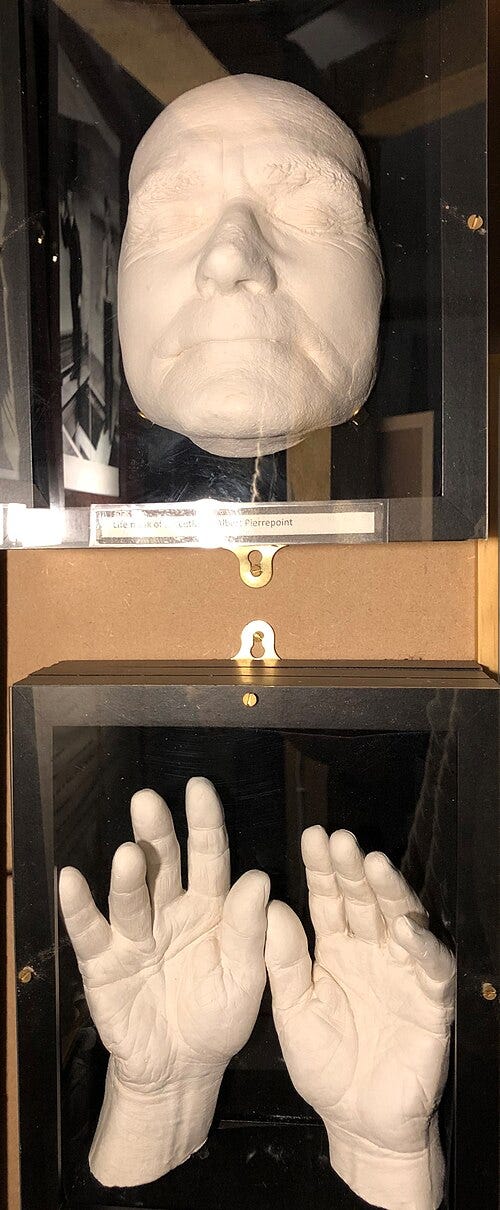
About his career and calling, Pierrepoint has said,
“…my job is sacred to me. That sanctity must be most apparent at the hour of death. A condemned prisoner is entrusted to me, after decisions have been made which I cannot alter…The supreme mercy I can extend to them is to give them and sustain in them their dignity in dying and death. The gentleness must remain.”
I guess you could say Albert liked working with people.
· Pierrepoint, Albert (1977) [1974]. Executioner: Pierrepoint. London: Coronet. ISBN 978-0-3402-1307-0.
· Wikipedia
· https://www.bbc.com/audio/play/p036bk5b
You made me feel compassion for the hangman. Well done.